What is ETCS? Understanding the European Train Control System
The European Train Control System (ETCS) is a railway signalling and train protection system designed to improve interoperability, safety and efficiency across Europe’s rail network.
The European Train Control System (ETCS) is a railway signalling and train protection system designed to improve interoperability, safety and efficiency across Europe’s rail network.
It forms a central part of the European Rail Traffic Management System (ERTMS), replacing or supplementing national train protection systems with a common European standard.
ETCS is a standardised signalling and train protection system developed to enable trains to operate safely across national borders without requiring different onboard control equipment for each country’s railway network.
Historically, European countries developed their own railway signalling and train protection systems. These systems often use different technologies, operating rules and methods of communicating information to trains. This creates technical barriers to cross-border operations, as locomotives and multiple units may need several different onboard systems to operate in different countries.
ETCS addresses this fragmentation by establishing a common system for communicating movement authorities and speed restrictions to trains, monitoring their operation and intervening when necessary to prevent unsafe movements.
It is one of the two main components of ERTMS, alongside the Global System for Mobile Communications – Railway (GSM-R), which provides voice and data communication between trains and railway infrastructure. However, GSM-R is being progressively supplemented and replaced by the Future Railway Mobile Communication System (FRMCS).
How Does ETCS Work?
ETCS relies on equipment installed both onboard trains and alongside the railway infrastructure. The two communicate to provide the train driver with information about the route ahead and the limits within which the train can safely operate.
The system works by calculating a permitted speed profile based on several factors, including:
- The train’s current speed and position
- The maximum permitted speed along the route
- The distance to the end of the train’s movement authority (the point up to which it is authorised to travel)
- The train’s braking characteristics
- Temporary and permanent speed restrictions
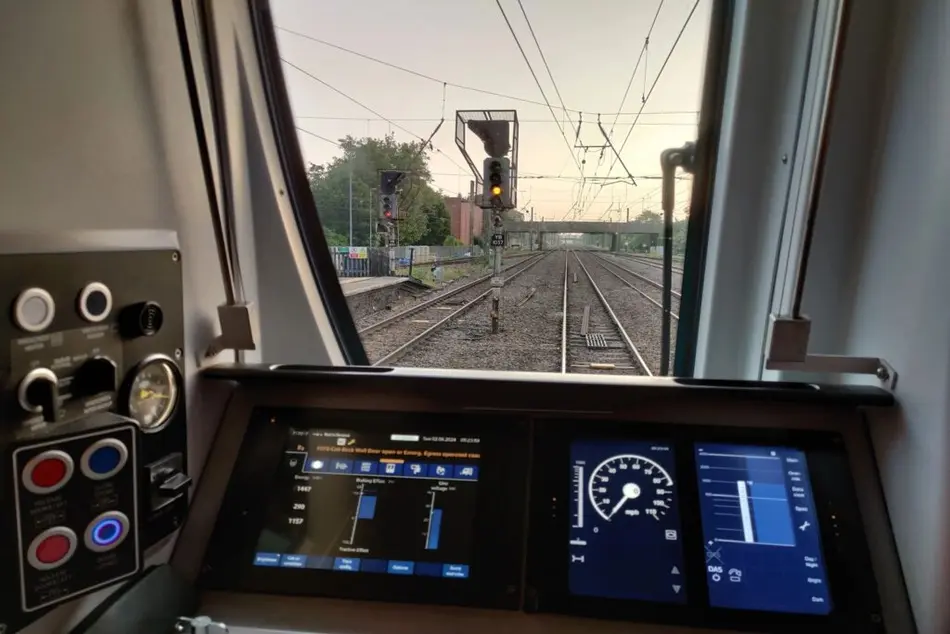
This information is processed by an onboard computer, which continuously monitors the train’s movement. The driver receives instructions through a Driver Machine Interface (DMI) in the cab, displaying information such as permitted speed, target speed and the distance to a change in speed restriction.
If the driver exceeds the permitted speed or fails to respond appropriately to a restriction, ETCS can issue warnings and automatically apply the brakes if necessary, including the emergency brakes.
ETCS Levels
ETCS can be implemented at different levels, depending on how information is transmitted between the trackside infrastructure and the train. The main levels used in current ETCS deployment are Levels 1 and 2.
ETCS Level 1
Level 1 uses Eurobalises, small electronic transponders installed between the rails, to transmit information to passing trains. These balises communicate with an antenna fitted underneath the train.
Communication is intermittent, taking place as the train passes the balises, but onboard speed supervision is continuous. Conventional lineside signals are generally retained.
ETCS Level 2
Level 2 uses continuous radio communication between the train and a Radio Block Centre (RBC), which manages movement authorities based on information from the signalling system.
Drivers receive signalling information directly in the cab. Conventional lineside signals can be removed, although they may be retained depending on the infrastructure and operational arrangements.
What are the benefits of ETCS?
The introduction of ETCS is intended to address several longstanding challenges facing European railways, particularly the lack of interoperability between national signalling systems.
1. Improved interoperability
One of the main reasons for developing ETCS was to remove technical barriers to international rail travel and freight transport.
Previously, trains crossing national borders could require multiple onboard train protection systems to operate on different networks. A common European standard reduces the need for this equipment and makes it easier for rolling stock to operate across different countries.
2. Improved safety
ETCS continuously monitors train speeds and movement authorities. If a train exceeds its permitted speed or approaches the end of its authorised movement without responding appropriately, the system can intervene by applying the brakes.
This provides an additional layer of protection against driver error and helps enforce compliance with signalling instructions and speed restrictions.
3. Increased network capacity
ETCS Level 2 can support more efficient train movements through continuous communication between trains and trackside systems.
By providing more precise information about movement authorities and braking distances, it can support shorter intervals between trains, depending on the wider signalling arrangements and infrastructure.
This can help infrastructure managers make better use of existing railway capacity, potentially reducing the need for extensive physical infrastructure upgrades.
4. Reduced maintenance requirements
ETCS Level 2 can reduce reliance on conventional lineside signalling equipment, potentially lowering infrastructure maintenance requirements.
A common European standard can also simplify the procurement, integration and maintenance of signalling equipment, although the actual savings depend on the network and implementation approach.
Challenges of Implementing ETCS
Despite its potential benefits, introducing ETCS across existing railway networks is a complex and costly undertaking. Implementation requires investment in both trackside infrastructure and onboard equipment. Infrastructure managers must install the necessary signalling and communication systems, while operators need to equip their fleets with compatible onboard technology.
As such, deployment across Europe is progressing unevenly. The European Union Agency for Railways’ 2025 interoperability overview highlighted the relatively limited overall deployment of ETCS and significant differences between countries. The European Union’s longer-term objectives include equipping the core Trans-European Transport Network with ERTMS by 2030 and the wider comprehensive network by 2050.
What Does ETCS Mean for the Future of Rail?
ETCS is an important part of the railway industry’s transition towards more connected, interoperable and digitally managed networks. By establishing a common train control standard, it can help remove technical barriers to international rail operations while providing a consistent approach to speed supervision and train protection.
It also provides a technological foundation for further developments, including Automatic Train Operation (ATO), which can automate certain driving functions while ETCS continues to provide the underlying safety supervision.
The long-term objective is a more integrated network in which trains can operate safely and efficiently across borders, supported by common digital signalling and communication technologies.