President Labels U.S. Attacks on Iran's Transport Infrastructure as War Crimes, Vows Legal Pursuit
Iran's President, reviewing the latest status of the country's transportation infrastructure and the damage inflicted on border terminals, ports, and road and rail networks, described the U.S. attacks on these civilian infrastructures as a clear instance of war crimes and emphasized the necessity of pursuing legal action through competent international organizations and authorities.
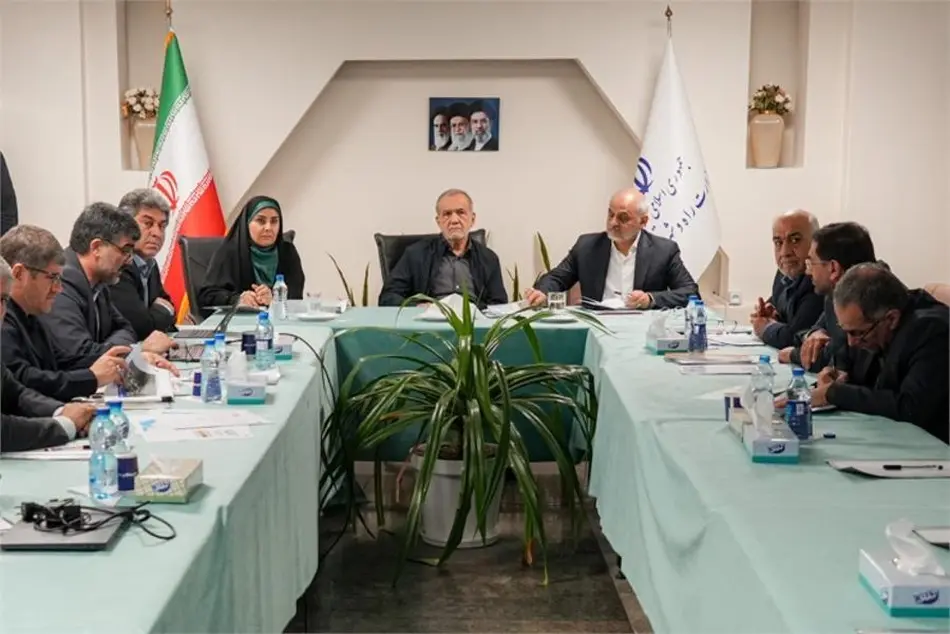
Iran's President, reviewing the latest status of the country's transportation infrastructure and the damage inflicted on border terminals, ports, and road and rail networks, described the U.S. attacks on these civilian infrastructures as a clear instance of war crimes and emphasized the necessity of pursuing legal action through competent international organizations and authorities.
citing the government's official news website, the President continued his field monitoring of ministerial performance by visiting the Ministry of Roads and Urban Development. In a meeting with the Minister, deputies, and senior officials, he reviewed the latest condition of the country's transport and logistics infrastructure.
During the meeting, a comprehensive report was presented on the status of border terminals, ports, road, rail, maritime, and air transport networks; the process of supplying, transporting, unloading, clearing, and distributing essential goods; the performance of customs offices; the condition of the country's roads; and measures taken to maintain supply chain stability and ensure the continuity of transport services.
The Minister of Roads and Urban Development also provided a detailed report on the damage inflicted on the country's transport infrastructure—including ports, border terminals, bridges, roadways, the rail network, logistics facilities, and other strategic infrastructure—following the U.S. attacks.
the President issued orders to accelerate the reconstruction of damaged infrastructure, activate alternative routes, enhance the resilience of the transport network, and facilitate service delivery.
Referring to the damage inflicted on border terminals, customs offices, and the country's land, rail, maritime, and air transport infrastructure, President Pezeshkian described these actions as a clear violation of international law and a war crime, stressing the need to pursue legal action through competent international bodies and organizations.
The President also highlighted the development of regional cooperation and the strengthening of infrastructural ties with neighboring countries as strategic government priorities. He stated: "The government's active diplomacy has provided a suitable platform for expanding transport and transit cooperation. Completing and connecting rail networks with neighboring countries can play an effective role in increasing economic resilience, developing international transit corridors, and maximizing the country's geopolitical potential."
Pezeshkian further emphasized the need to rebuild and modernize damaged terminals and infrastructure based on international standards. He said: "We must seize this opportunity to build infrastructure that meets the highest global standards in warehousing, logistics, cargo handling, smart management, and modern technologies. This approach will not only increase productivity and improve service quality but also reduce operational costs and enhance the efficiency of the transport network."
In another part of his remarks, the President appreciated the tireless, dedicated, and responsible efforts of the managers, experts, and staff of the Ministry of Roads and Urban Development. He described the continuity of services, the stability of the transport network, and the prevention of any disruption in road, rail, air, and port services as a testament to the commitment, efficiency, and service-oriented spirit of the ministry's team.
Pezeshkian emphasized: "With this same spirit, the diligent efforts of all government bodies, and the cooperation and support of the people, all plots and schemes by enemies to disrupt services and the country's infrastructure will be neutralized."
During the meeting, Dr. Pezeshkian also held telephone conversations with the head of the Road Maintenance and Transport Organization, the Director General of Road Maintenance and Transport of Hormozgan Province, and a contractor active in the Ministry of Roads and Urban Development who were working in operational zones on the front lines of reconstruction and maintaining the stability of the transport network. Expressing his gratitude for their round-the-clock efforts, he praised their sincere and dedicated services and wished them continued success.