Predictive Rail Asset Maintenance: From Concept to Reality
Explore why rail asset maintenance is at an important point of change, the opportunity created by predictive technology, and how Tracsis is making significant progress to bring the next generation of rail asset monitoring into operational use.
Explore why rail asset maintenance is at an important point of change, the opportunity created by predictive technology, and how Tracsis is making significant progress to bring the next generation of rail asset monitoring into operational use.
Executive Summary
Rail infrastructure managers are under sustained pressure to improve reliability, safety and efficiency across increasingly complex, busy networks. Simultaneously, many maintenance decisions rely on reactive or scheduled inspections, predefined alarm thresholds and manual interpretation of large volumes of asset data.
These approaches have underpinned the development of modern infrastructure management, but the wider context is now changing. Networks are carrying increasing amounts of passengers and freight, maintenance access remains constrained, regulated and costly, financial pressures are intensifying, and teams are expected to extract greater value from existing assets and resources. In this context, existing ways of working are increasingly limited.
But rail has the foundations in place for a different approach. Remote Condition Monitoring (RCM) systems now collect enormous quantities of asset data. Additionally, advances in machine learning make it feasible to analyse that information at a scale and consistency that would have never previously been possible.
The opportunity is to combine these two advantages into reliable condition prediction. To make this a reality, Tracsis is actively developing an advanced predictive monitoring capability as an extension of its established RCM ecosystem to:
- Identify patterns associated with emerging faults before usual alarms are triggered
- Monitor thousands of assets simultaneously and direct engineers towards those presenting the clearest signs of developing risk
- Support more targeted inspections and interventions, reducing unnecessary maintenance activity and trackside access
- Improve asset reliability and potentially reduce service-affecting failures
- Provide a clear picture to infrastructure managers, giving a more consistent basis for balancing safety, performance and maintenance cost
- Extend RCM’s usefulness from an operational visibility platform into an intelligent maintenance decision-support capability.
The technology is in active development, but reaching the accuracy and reliability required demands extensive testing and high-quality data. To achieve this, Tracsis has developed a predictive platform for deployment in the field with select client partners. This is enabling the next key phase of training, evaluation and model refinement using data and feedback from some of the world’s busiest rail networks in live operational environments.
This article explores why rail asset maintenance is at an important point of change, the opportunity created by predictive technology, and how Tracsis is making significant progress to bring the next generation of rail asset monitoring into operational use.
Maintenance Models Must Evolve with Rail
The Operational Challenge
Railway maintenance has always required a difficult balancing act. Infrastructure managers need to identify and address deterioration early enough to protect safety, reliability and network performance, but intervention itself also carries a cost.
Inspections require engineering resources, trackside activity can demand detailed planning and safe access arrangements, and component replacement generates labour and material costs. On a busy railway, maintenance activity may also compete with the operation of passenger and freight services for access to the infrastructure. In combination, these factors make both late and unnecessary intervention costly and time-consuming.
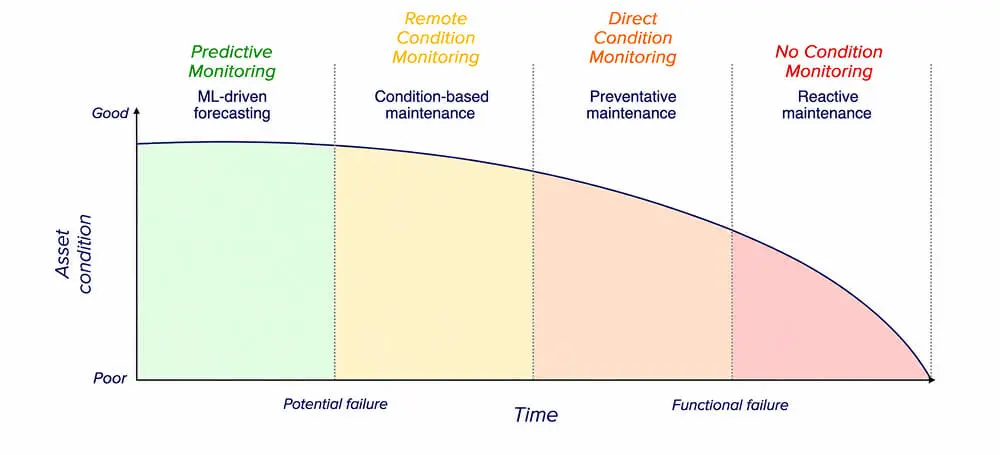
To prioritise work effectively, infrastructure managers need to answer one fundamental question: which assets require attention, why, and when? On modern rail networks, the answers are usually determined by one or more of three progressively sophisticated approaches:
- Reactive maintenance , where an asset operates until a fault or failure requires intervention.
- Preventative maintenance , where work is carried out at predetermined intervals in an effort to pre-empt failure.
- Condition-based maintenance , the most advanced model widely available, where RCM platforms track asset data and help teams intervene according to the observed state of an asset.
But even with these strategies, asset insight is largely limited to real-time condition or performance, severely limiting efficiency across large-scale networks and thousands of assets.
The clear opportunity is therefore to become more targeted, moving away from legacy models and increasingly towards risk- and condition-led decisions, in part enabled by emerging predictive technology and represented by another stage of the progression scale:
4. Predictive maintenance , the next technological step, where historical and live condition information is analysed to anticipate deterioration and indicate when intervention is likely to become necessary.
Why Now? The Conditions Are Set for Industry Transformation
Predictive maintenance has been discussed in rail for years, with very little to show for it in terms of deployable solutions. Now, the combination of better data, new technology and growing operational need has meant viable predictive maintenance is moving from concept to reality.
Operators globally are entering a generational push for modernisation, with examples such GBRx in the UK specifically prioritising the exploration of artificial intelligence in various use cases, including asset management.
Growing Pressures: A Need to Do More with Less
Several changes are making innovation increasingly important. The first is network utilisation. This growing use of infrastructure makes reliability more crucial than ever, while putting greater pressure on the assets supporting the services. And in a purely practical sense, a busy operational railway is harder for engineering teams to access.
Secondly, financial pressures are growing. Globally, the rail industry is being asked to deliver more, with greater efficiency, all within a challenging cost environment being driven by inflation and other financial constraints. Maintaining existing assets efficiently and sustainably helps operators achieve savings, so the pressure inevitably cascades down to on-the-ground infrastructure teams.
Finally, the technology needed to approach maintenance decisions differently is now developing rapidly. Artificial intelligence and machine learning technology are now vastly more affordable, accessible and capable than ever before, meaning the pressure to utilise it – and the opportunity cost of not utilising it – are building.
Better Data: Remote Condition Monitoring Has Laid the Groundwork
RCM has already changed the relationship between engineers and infrastructure. Rather than relying exclusively on physical inspection to understand asset behaviour, engineering teams can remotely view data from geographically dispersed equipment. Depending on the asset, this might include measurements such as electrical current, hydraulic pressure, position, movement, operating time and other technical variables. This provides a much richer picture of condition than was previously possible.
Current RCM approaches typically use configured rules and thresholds to help teams identify potential problems. When a measurement moves outside an expected range, an alarm can direct an engineer towards the affected asset. This is hugely valuable, but it has limitations as a threshold only provides part of the picture.