|
News Code
64875
Copied
DNV GL to focus on shippings current and emerging risks
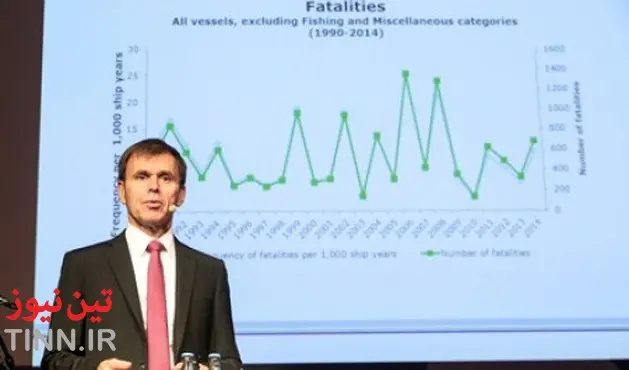
TIN news: A greater focus on cyber security is essential to combat the risk of criminals exploiting already existing vulnerabilities," he pointed out.
Programmable connected components, whether machinery, navigation or communication systems, were violable to potential cyber-attack. But more than that the risk of incidents caused by software-related issues due to simple error, malfunction or breakdown meant that ensuring total system integrity was a critical safety issue, he said.
The "connected ship", or a vessel with many software-dependent systems, an online presence and high levels of automation, was arriving much more quickly than anticipated, Mr Svensen noted. As a classification society, DNV GL advocated a risk-based approach to reduce cyber threats, with a tiered approach of third-party assessments, audits, testing and verification.
Meanwhile, navigational errors still account for too many shipping accidents, he said: "It is worrying to see that despite all the modern equipment on board, human error is on the rise and is now responsible for over 50 per cent of all claims."
In this context, industry stakeholders needed to work closer together; sharing information on accidents in order to learn and to progress, Mr Svensen said. Finally, he noted that even though the long term trend was positive, shipping was still lagging behind land based industries.
Also during the IUMI 2015 event, DNV GL Maritime VP Fleet in Service, examined issues surround container stacking and lashing. Breaking down some of the common incidents and the reasons behind container losses and damages, Mr Galle emphasized the importance of correct lashing and stowage procedures, combined with function testing of equipment. Mr Galle also presented the innovative DNV GL Route Specific Container Stowage class notation.
Developed at the request of several container liners, DNV GL experts worked to implement procedures that would allow transportation of container cargoes based on the actual route travelled by an individual vessel. The resulting calculations, which account for the greater width and size of newer vessel designs, improve safety while giving operators enhanced vessel flexibility and utilization.
Over the last few years, there has been increasing discussion on the possibilities of unmanned or autonomous shipping. In his presentation Hans Anton Tvete, Senior Researcher for Maritime Transport, DNV GL - Strategic Research & Innovation, looked at the ground-breaking DNV GL research project "ReVolt", a concept design and working scale model for a small zero emission unmanned cargo vessel.
Inspired by the need to reduce road congestion in Europe and Scandinavia, ReVolt is battery powered, highly efficient, completely autonomous and based around already existing technologies - a fascinating look ahead at the future of the shipping industry.
In his capacity as Chairman of the IACS expert group for container ships, Holger Jefferies, Program Manager for Class Development at DNV GL, looked at "Recent Developments in the Classification of Containerships", setting out how IACS has expanded the scope of its current unified requirements for container ships.